Icetech
Italy.
A complete digital rebuild for one of Italy's leading gelato machinery manufacturers. Five languages, 30+ catalogued products, a global dealer map, and a virtual showroom — all shipped before the industry's peak trade season.
Visit Live Site ↗- Client
- Icetech Italy
- Year
- 2025
- Timeline
- 10 weeks
- Role
- Design & Dev
- Stack
- WordPress · WPML · Custom Theme
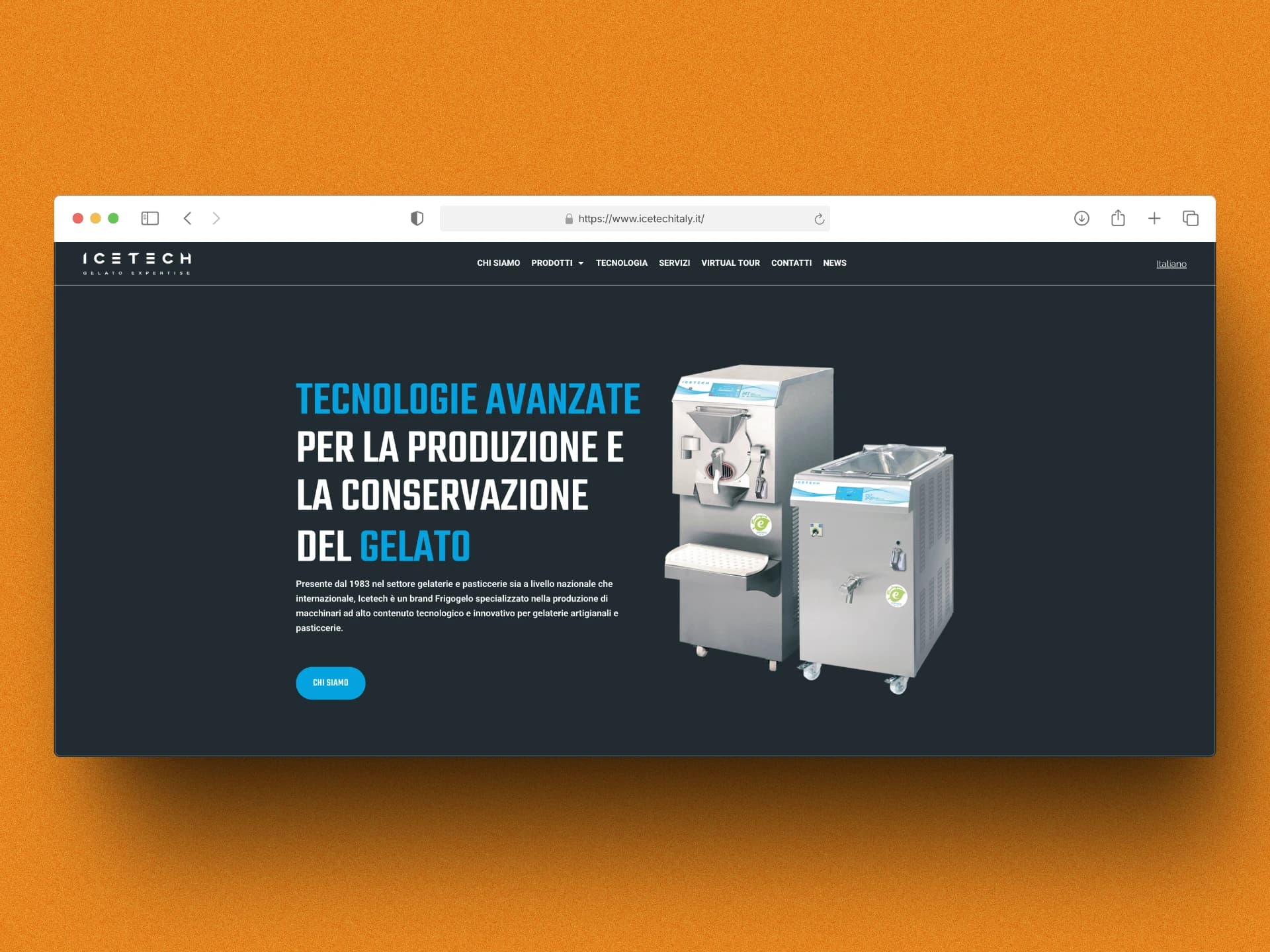
40 Years of Gelato.
A Website That Wasn't Keeping Up.
Icetech Italy — a Frigogelo brand — has been manufacturing professional gelato and pastry machinery since 1983. Their machines are used in artisan gelato shops, patisseries, and large industrial plants across more than 100 countries. Their website, however, hadn't kept pace with that international footprint.
A static, single-language site was quietly costing them leads in France, Spain, the Netherlands, and across the English-speaking world. The product catalog was hard to navigate, technical data sheets were buried or absent, and the global dealer network was invisible to anyone landing from outside Italy.
Four Failures.
One International Opportunity.
Monolingual site
The entire site was Italian-only. International distributors and end customers in France, Spain, the Netherlands, and English-speaking markets had no localised experience — and no incentive to stay.
Catalog dead-ends
30+ products across 5 categories with no filterable navigation. Users reached product pages via a flat list — no hierarchy, no cross-links between related machines, no path to technical detail.
No dealer visibility
Icetech operates through a global dealer network, but the site gave no indication of where to buy. International visitors had no path from product interest to purchase contact.
No technical depth
B2B buyers need specifications, dimension sheets, and energy ratings before contacting a dealer. None of this was accessible. Every evaluation started with an email to the sales team.
Core insight: a multilingual B2B site isn't a translated website — it's five separate user experiences sharing one codebase. Build the architecture once, correctly. Every other problem follows from that foundation.
Four Principles
That Shaped Every Decision.
Before a page was designed, the structural and technical questions were settled. The design system, templates, and content all followed from these choices.
Language architecture before content
Rather than retrofitting translations onto an existing structure, the content architecture was built to support five languages from day one. Clean subdirectory URL slugs, hreflang on every page, and a WPML translation workflow the client team manages without developer involvement. The Italian URL is canonical; all four translated versions share the same authority.
→ Subdirectory routing (/en, /fr, /nl, /es) was a deliberate SEO call — consolidates domain authority rather than splitting it across subdomains.Catalog hierarchy that matches how buyers shop
32 products mapped into a five-category taxonomy (Artisan Gelato, Soft Ice Cream, Patisserie, Display Cabinets, Large Plants). The sidebar-driven catalog lets buyers filter by category without leaving the listing view. Related machines link to each other. The hierarchy matches how buyers describe their need, not how Icetech internally organises their product line.
→ Category labels were tested against how international distributors describe their search — “soft ice cream machines” not “prodotti categoria 3.”Technical depth on every product page
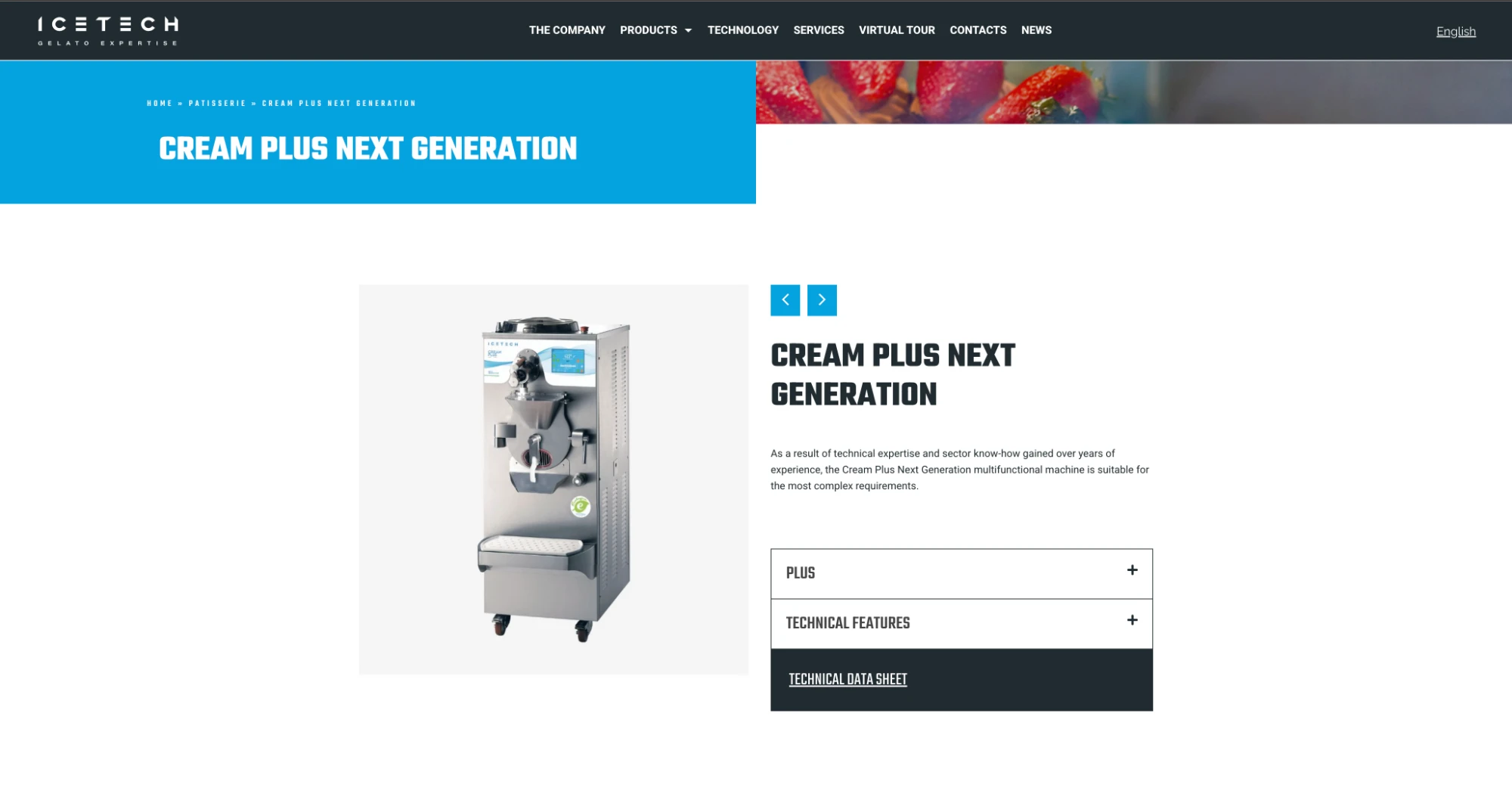
Each product page was designed as a self-contained evaluation resource: image gallery, expandable spec accordion (dimensions, power, capacity, weight), downloadable technical data sheet, and a contextual dealer CTA. B2B buyers should be able to complete 80% of their evaluation without contacting anyone — contact is reserved for finalising, not starting.
→ Data sheet standardisation was added to scope after the first batch arrived as inconsistent InDesign exports — a lesson built into the brief from the start.Brand-matched interactive features
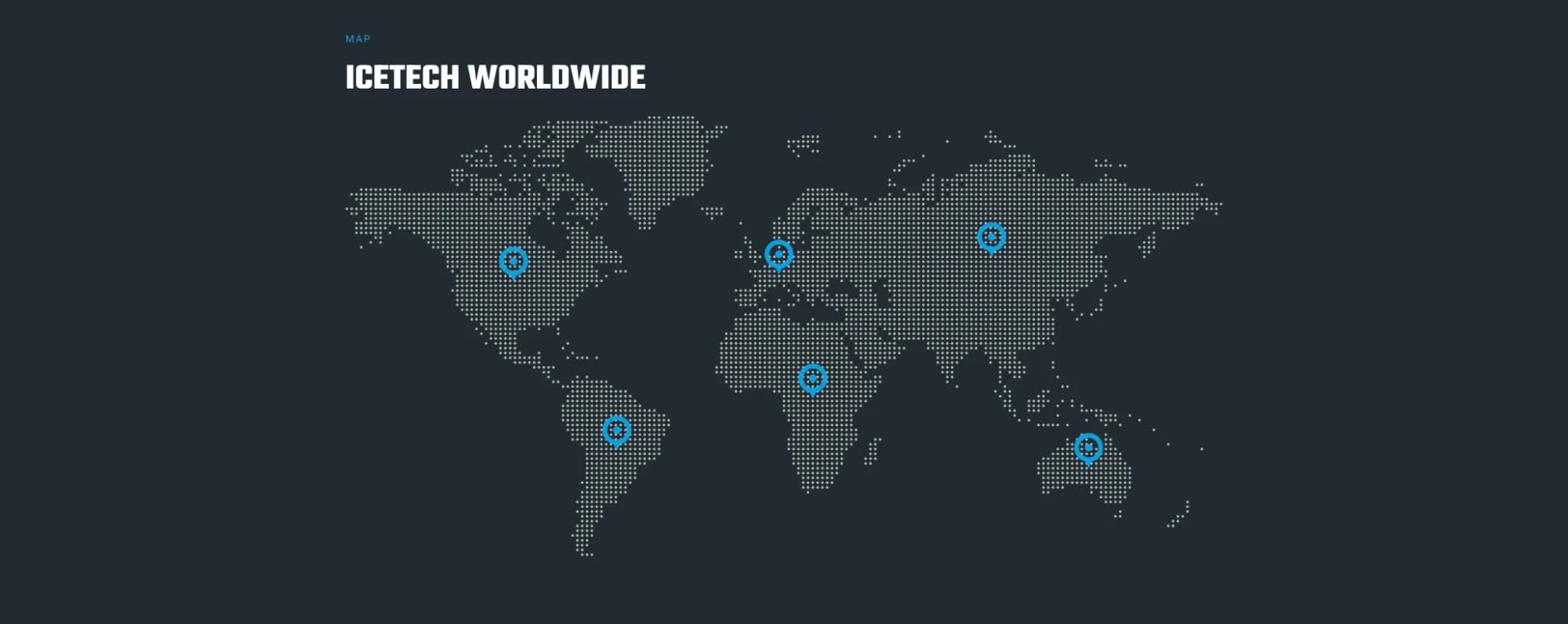
The “Icetech Worldwide” dealer map is a custom SVG dot-matrix — not embedded Google Maps. It loads in milliseconds, needs no API key, matches the dark navy theme exactly, and serves no cookie banner. The 360° virtual showroom integrates as a nav-accessible embed, not an external link. Both features are fully translated across all five locales.
→ A brand asset that also functions as a feature. The map communicates global reach before a buyer reads a word of the page copy.Three Screens
That Defined the Build.
Each screen solved a distinct problem — catalog discovery, dealer reach, and product evaluation depth.
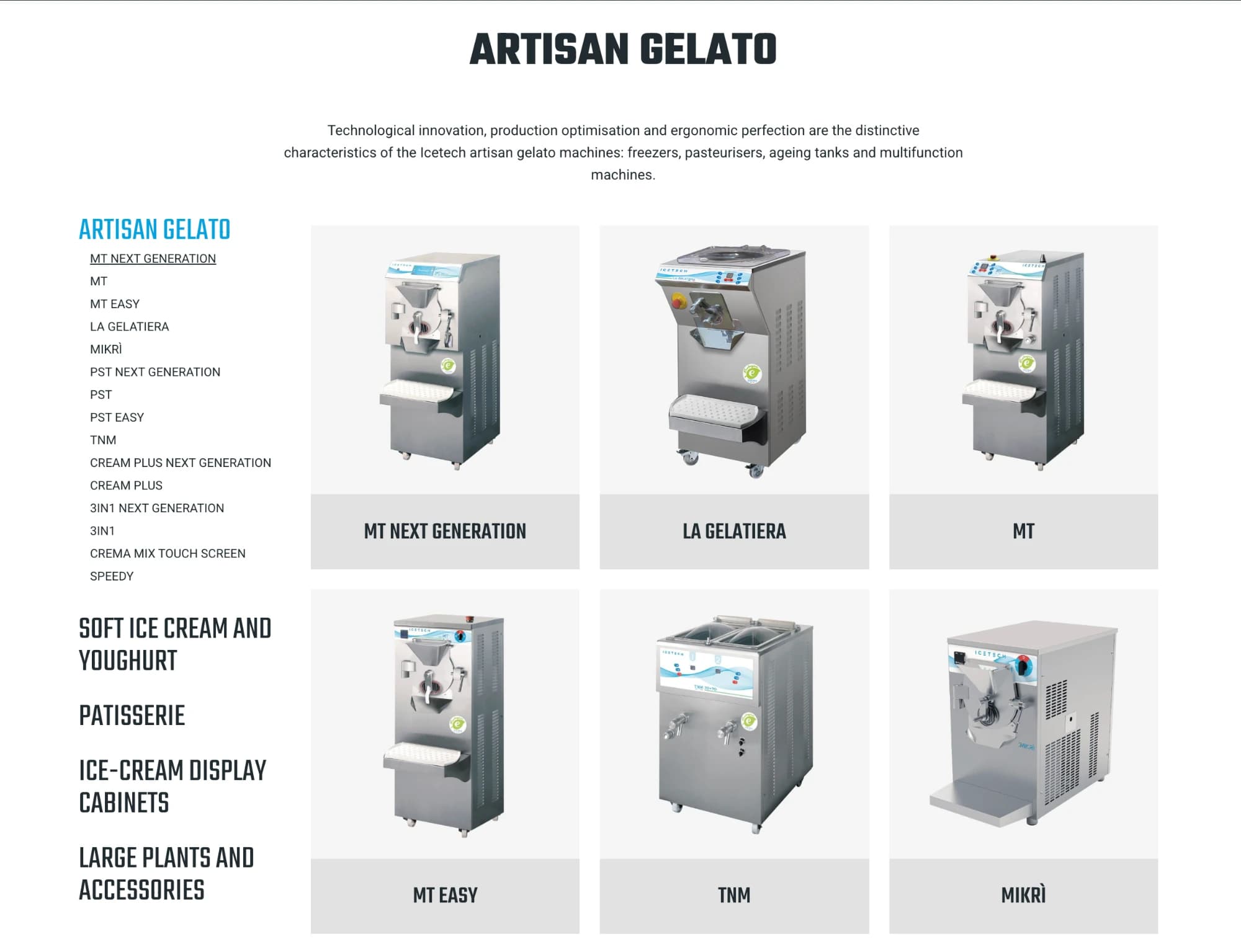
Product catalog: sidebar taxonomy + filterable grid
The old site presented products as a flat list. The redesign introduces a persistent sidebar with five category filters and a three-column product grid. Switching category reloads the grid without a page reload. Each card shows the product name, a machine visual, and a quick-spec summary. The catalog is fully translated — category labels, product names, and spec terminology all localised per language.
Icetech Worldwide: the dealer map as brand statement
The brief asked for a dealer locator. The result is a section that communicates global presence before a buyer reads the headline. The SVG dot-matrix world map with cyan dealer pins across six continents loads at zero cost, matches the dark theme without approximation, and scales cleanly to any screen. Dealer regions are clickable — each opens a contact card for the local distributor.
Product detail: self-contained evaluation page
The product detail page is the conversion point for B2B buyers. Image gallery, expandable spec accordion with dimensions and energy ratings, and a downloadable technical data sheet — all above the dealer CTA. The goal: a buyer can complete their technical evaluation without sending an email. Contact is reserved for finalising, not qualifying.
Five Languages.
One Codebase.
WPML with clean subdirectory URLs, hreflang on every page, and a translation workflow the client team manages independently. Zero developer involvement to publish new content or add translations after handoff.
International Traffic.
Measurable Leads.
Measured at 60 days post-launch against the same period the prior year. The multilingual SEO lift was the headline — but the increase in dealer contact form submissions from non-Italian visitors was the result the client cared about most.
Why These
Choices?
Three calls with real tradeoffs, and the reasoning behind each.
over headless
vs. subdomains
vs. Google Maps embed
What I'd Do
Differently.
Ten weeks across five languages and 32 product pages. A few things I'd change if I ran it again.
✗ Define the translation workflow at kickoff
The WPML translation workflow was defined in week 8 instead of week 1. Translated content arrived in a format that didn't map to the field structure we'd built. A 30-minute workshop with the translator at project kickoff would have saved two days of late-stage rework.
✗ Standardise data sheet format in scope
Data sheets arrived as InDesign exports — each a different size, orientation, and visual style. We shipped functional but inconsistent PDFs. Standardising the template should have been a deliverable in the brief, not an assumption.
✗ Country-level keyword research, not translated targets
The initial keyword strategy was translated directly from Italian targets. Each language version needed its own research — search intent for professional gelato equipment varies significantly between French patissiers and Dutch soft-ice operators. Localisation isn't just translation.
✓ Virtual tour as a nav feature
Making the 360° showroom accessible from the main navigation — not buried in a product page — drove significantly more engagement than expected. Users treat it as a trust signal before evaluating individual machines.
Finally a site that works for our international distributors. We're getting enquiries from markets we couldn't reach before.Marco Ferri, Export Manager — Icetech Italy